Wisdom, Intelligence, and Unanswered Questions

I don’t know if this is a discussion most people have with any kind of frequency but, as a D&D player, I’ve often discussed the difference between wisdom and intelligence.

The trickiest part of the whole discussion is that it feels like the distinction is super clear in your mind, but the actual explanations you try to provide always wind up feeling hollow, inadequate, or you just can’t think of any. The popular explanation in D&D groups follows the “Tomato Explanation” of character attributes. “Strength is your ability to crush a tomato. Dexterity is your ability to dodge a tomato. Constitution is our ability to eat a bad tomato. Intelligence is knowing a tomato is a fruit. Wisdom is knowing not to put a tomato in a fruit salad. Charisma is being able to sell a tomato-based fruit salad.”

There are any number of jokes that go along with this (my favorite is pointing out that a tomato-based fruit salad is salsa and then someone else declaring that I’m the party’s bard now), but they all ignore that you could easily make the argument that describing salsa as tomato-based fruit salad is actually an aspect of intelligence. As is knowing that tomatoes don’t pair well with most fruits. Any time a player makes a claim about how the mental attributes work, another player could make a convincing argument that all of those examples are actually just all a part of the same attribute.

Then, when you take these discussions out of their D&D context, you continue to run into the same problem. Is making good decisions really the result of being wise, or is it an aspect of being intelligent? Are you able to anticipate the outcomes of your actions because some innate part of you understands the correct choices or are you able to predict the end results of what you do because you can understand all the variables and their consequences? Hell, is this even a distinction worth making at all?

I’m fairly certain that wisdom and intelligence their own, discrete things. Maybe their differences aren’t super apparent when people have relatively similar amounts of each, but more extreme example make it much more clear.

Take, for instance, this software developed I worked with at my last job. He pushed at the very edges of what our code was able to do, creating these incredibly complicated activities that expanded what our customers thought was possible and laid the groundwork for future expansion beyond even that. He was probably one of the smartest people I’ve ever met. At the same time, by the end of his first year at the company, I was the only person who could work with him. I worked with him for almost two years and the next longest anyone else worked with him was 6 months. Third was 7 weeks. To put it bluntly, he was a condescending asshole who constantly belittled and insulted his coworkers, even if it wasn’t on purpose most of the time.

His example makes it pretty clear that intelligence isn’t something you can substitute for wisdom or charisma. On the other hand, one of my current coworkers is a super nice and competent guy. He’s better at his job than I can hope to be in anything less than a decade (we have the same job, he’s just the Senior version of it) and he has these piercing insights into how our whole team functions, along with being able to talk through things with people so that they come to see their best course of action. However, if you explain a new idea quickly, he can struggle with it for a bit before it finally clicks for him. Which shows plenty of wisdom can’t be substituted for intelligence.

To put it simply, I think wisdom is the ability to explain and intelligence is the ability to learn. I think the reason people have a hard time distinguishing between them is that they feed into each other. If you can learn easily, you are better equipped to explain things and being able to explain things well means that you have more opportunities to learn, even if you’re just learning from yourself. I can explain stuff to people very well because I know a lot, which means I can draw upon a lot of different comparisons so that what I’m explaining is housed in terms that are easy to understand. I also couldn’t begin to count to the number of times I’ve suddenly had a flash of insight into something when I’m trying to explain it so someone.

Despite the similarities between wisdom and intelligence, I think it is important to be mindful of the differences. If you start to conflate the two, you can wind up in a lot of awful situations because you relied too heavily on one when you needed the other. I can easily recognize when something I’ve said is wrong or has been misinterpreted based on people’s reactions (intelligence), but being able to anticipate that reaction and changing it beforehand (wisdom) is always better than apologizing and clarifying. Sure, it isn’t entirely reasonable to expect myself to always be able to do that, or to even spend so much time measuring my own words, but making a habit of sticking my foot in my mouth is also a pretty shitty way to live, even if I apologize afterwards.

I reflect on this a lot, specifically in the terms of thinking about how my communication affects other people. I spend more time measuring my words than I do speaking. To be honest, one of my biggest issues with myself is just how much I censor myself when talking to people: how much effort and energy I put into delicately phrasing things so as to not offend. This blog is supposed to be part of my effort to not spend so much time holding my silence, but I find myself avoiding certain topics and thoughts I’d like to explore because I know family and friends read this blog.

Maybe this is one of the reasons I feel like I haven’t made much progress in the past few years. Maybe I feel like I’ve stagnated because I’m blocking my own words, feelings, and responses in favor of giving other peoples’ higher priority. Maybe I’m writing this blog post without any insights and only unanswered questions because I don’t want to confront the truth that’s sitting right in front of my face, but is still somehow hidden from my conscious sight. Or maybe I’m just going to keep asking myself this question for my entire life, and this entire blog is just one more way to explore possible answers.

Wisdom says focusing on questions gets you further than focusing on answers. Intelligence says that some questions have no answers and just mulling them over is enough to promote growth and mental development. I say that, like almost everything in life, the answer to this particular question is going to be something along the lines of “take care, but not too much.”
We Try Things. Occasionally they even work.

So, I’ve once more been struggling with my depression. Big surprise there. Kinda snuck up on the back of some of the stuff I was writing last week and just overwhelmed me when I wasn’t paying attention. Luckily, with my renewed focus on watching for it and the help of my friends, I was able to notice it quickly and come up with a few plans to circumvent it.

Historically, working out every day has been a good way to deal with my depression for a few reasons. There’s the health reasons, studies that suggest that regular exercise can have a significant positive impact on one’s mental well-being. There’s the easy reasons, that I’m generally too tired after a heavy workout (and those are the only kind I do) to be anything. Then there’s the mental reasons, that I’m finally making progress on one of my big goals by losing weight. All of that together leaves me at least neutral for as long as I can keep it up (usually 3-5 weeks) though I get almost nothing else done.

Another, more mentally productive, way to deal with my depression is by creating something. Writing is often a good way for me to take a step away from everything and let my mind work out my problems through my stories. When I was in college, working on building a set for a show or helping put together some internal improvement project for the theater was always very relaxing, letting my focus and keep busy while leaving my mind free enough to work through things in the background. Unfortunately, I’m not very good with music or visual arts, but I’m certain those would be just as helpful. Anything that gets me focused on and engaged in the act of creation always helps.

Sometimes, even working a lot (at my job) can help, if I’ve got the right kind of projects. Put in some overtime, rake in that delicious OT pay, and start making even more progress toward being debt free. A good amount of rewarding work (people recognize what I’m doing as being useful and I can contribute to the good of my team/company) is just the right kind of mentally exhausting. I get so wrapped up in what I’m doing to let my problems in and then I’m too tired to make myself fret about anything.

All three have worked individually in the past. Unfortunately, none of them would last for long. I wear myself out to the point of not being capable of working out again, or I get finish a project and can’t figure out the next steps, or I finish whatever work project had me so focused and I’m unable to find a new one to fill that hole. Eventually, they all come to an end.

Which is why, this time, I’m trying all three at once. Work 10 hours days and try to get super invested in an interesting work project. Workout immediately after work. Come home, eat something, have a cup of tea to help me stay awake, and then write/try-to-write until 11 or 12. The idea being that, when one of the three fails, I should still have the other two continuing on to prop me up until I manage to get the third one going again. So far, it’s working out pretty well.*

First, I pushed myself too-hard in my workouts initially and had to really dial it down, but that means I’ve just got a little more time and energy for writing. Then I picked my workouts back up again, full-force, and was too tired to write for a couple of nights, but since I workout after work I was able to continue investing in my latest work project.

Unfortunately, there are still some flaws. After an entire week of this, I hit Friday and couldn’t do anything after 1:30. I had to run a meeting about my project which taught me a lot and forced me to herd cats for an hour and a half. Senior Coworker Cats. Some of whom had been at the company longer than I’ve been alive. I went home pretty much immediately afterward and decided to take all the pictures off my phone as my day’s project. 800 pictures later, I played a few rounds of video games with friends and went to bed.

All-in-All, it seems to be working aside from a few quiet moments here or there were I just kinda feel sad, but those are growing shorter and less frequent after only a week. Maybe, if I can keep this up long enough, they’ll disappear entirely.


*Side-effects of the pursuit of three major goals may include drowsiness, irritability, a zombie-like demeanor, and a severe allergic reaction to social interaction. But hey! At least you’re not a depressed sack of sad!

Saling Away

One of the most frustrating experiences for me, in a definite “First World Problems” kind of way, is being in a bookstore during a sale and not being able to take advantage of it. Not because I lacked the funds to buy more books, of course, but because I couldn’t find more books I was willing to buy for full price.

I was at my local Barnes & Noble just yesterday, Starbucks coffee in hand, looking for the next volume of a manga I’m readying. While lazily scanning the shelves, I found that there was a sale on manga: buy two, get the third for free. Unfortunately, I couldn’t find another series that looked super interesting to me based on the cover and a quick skim. For those of you who read manga, you know that’s a pretty terrible way to judge them, but there’s not much else to go off of other than that without a recommendation from a friend or trusted reviewer. My go-to friend was busy ignoring his phone and none of the review sites I checked could help with my selection, so I had no help at all.

After futilely wandering the manga section for another 10 minutes without a reply from my friend, I made my peace with my single purchase only to go over to the mass-market paperback section and find a similar sale. Buy two, get the third for free. There was only one Terry Pratchett book in that section that I didn’t own and none of the other books looked terribly fun or engaging.

Being a somewhat picky reader, I couldn’t find any information from my trusted sources without searching every title individually and I had been standing around for long enough already that any more time would have felt awkward. Especially because a whole slew of people had come and gone while I dithered. I skimmed around for the other books I wanted–a replacement copy of Red Rising since I stuck my old copy in a Christmas grab bag and the third book in the trilogy, Morning Star–but none of them were a part of the sale.

There I was, standing around with two books that were a part of identical sales but didn’t qualify for each other’s sale (yeah, I asked), and zero inclination to buy anything else I could find. So I took my four books, grabbed two more Pratchett books that weren’t a part of the sale, and cried bitter tears as I said good-bye to my chance at cheap new books. It was a tough thing to do, to walk out of there with a sale whispering sweetly into my ear and wallet, but I had nothing to buy.

If you should happen to find yourself in a similar place, I’ll make some recommendations now so you can avoid my pitiable fate. I highly recommend checking out Tokyo Ghoul if you don’t mind a little gore and would like a refreshing and well-written take on zombiism. It follows the life of a young man who gets turned into one of these “ghouls” as the result of a life-saving surgery and how he struggles to find his place in both societies. There is plenty of action and drama, but the characters are endearing, believable, and worth the wait for each new volume.

As far as sci-fi goes, I recommend the Red Rising trilogy–by Pierce Brown–if you like sci-fi and social commentary. It’s a bit heavy-handed at times (nowhere near as heavy-handed as some of the older sci-fi is, though) and a bit dense to read because of the stylized language Brown uses, but it’s definitely a pleasant read and a very engaging story. The protagonist is a young man from the lowest caste of society, a Red, who is the chief earner for his clan, who takes his place in a rebellion against their Gold overlords after his wife is killed for singing a particular song.

In less detailed terms, Brandon Sanderson is always enjoyable and anything by Jim Butcher is worth a read. Terry Pratchett is great for humor, as is Douglas Adams. Stephen King is great if you enjoy macabre stories and crude shock-value (seriously, the guy breaks/challenges social rules purely for the shock value they bring to his stories). Brian Jacques is one of my first favorites and Terry Brooks has a large series out that is now drawing to an end. I’ve got plenty more where all that came from, but dropping all those names would double the length of this blog post, so I’ll leave it at that for now.

Happy Saling!

A Little Perspective Can Go a Long Way

I’ll admit that I was rather surprised by some of the responses I got to yesterday’s post. I got a couple of messages from friends who were concerned about me (thanks again for caring enough to talk, it really does mean a lot to me, whatever I might say in response) and then, because I didn’t think what I’d posted had been dark enough to warrant that level of concern, I asked my closest friend for her perspective.

She told me that it was, in fact, darker than I’d thought and, furthermore, most of my interactions with her had become rather focused around my depression. She wasn’t complaining of course, mostly just reinforcing the realization I was coming to.

One of humanity’s trademark abilities is adaptability. Every sci-fi and fantasy depiction of humans–as compared to other races or beings–has made the point that humans can survive anywhere and get used to any circumstance. It’s pretty well exemplified in the real world as well. As soon as a city is destroyed by an earthquake, a flood, or a tornado, we immediately begin to rebuild right where we were. Maybe we upgrade some stuff to make us more likely to survive next time, but we just adapt to our environment rather than find someplace less hazardous.

I’ve been the same way my entire life. Every time something bad has happened, I’ve just figured out how to cope and then carried on. I adjusted. Sure, that meant sometimes shoving things so far out of my mind that it took 7 years of my life and 4 years of therapy to be able to feel something about it again, but I managed to survive the encounter and continue living my life. I adapted to my new life and even thrived.

So when it comes to talking about my depression and how bad things have gotten for me, I’m going off a baseline created from three years of being over worked, under appreciated, and held to impossible standards at a job I couldn’t afford to leave. All that on top of all the crazy, unfortunate stuff that happened to me in the 21 years before getting that job. I got used to being pretty much low-key depressed all the time. I stopped expecting to have any kind of happiness from day-to-day and settled my hopes on just not being miserable.

I adapted to my situation by removing expectations and hopes that would accentuate the bad situation I was. In doing so, I lost my frame of reference for what was acceptable and how bad some of my issues were. I also made a point to remind myself, when empathizing with other people, that everyone has their own scale for what they’re capable of dealing with and what they’d consider to be “the worst.” Throw both things together and I wound up not only with no frame of reference or ability to concretely measure my own suffering, but also with a poor ability to realize what my own suffering sounds like to other people.

So now I make blog posts like yesterday that make me sound really miserable because I honestly am and fail to really notice the true extent of what I’m saying because I’ve been more miserable in the past. It takes people reaching out to me to notice. Which means I’d ignore problems that are slowly becoming worse like the proverbial frog placed in a pot of water that is then set to a boil.

I think what I need to do to remedy this is not only be more mindful of where I am in my life and what’s going on with me, but I also need to broaden my blog topics a bit and focus a little more on constructive conversation around depression rather than just letting off steam. Maybe advocate to remove the stigma a little more emphatically than just leading by example. I mean, it’s always been my intention to do that to some degree or another and I’ve already figured out exactly what I’d do with my money if I became a super rich author (throw money at that problem as well as words), but I think I can do more, even now. There’s really no better time to start something than “now”.

I’m a tall, middle-class white dude with a degree in English Literature, which means I’m not super qualified to do much on most current topics other than support and align myself with the downtrodden and put-upon. The only exclusion is mental health. After my personal experiences and all my years of therapy, I think I’m pretty qualified to join the conversation, at the very least, even if I’m not an expert.

Hi, my name is Chris, I’m a dude with emotions that are hard for me to talk about because I’ve been taught that I’m not supposed to share them and I tend to lose sight of my ability to properly care for myself because I was taught that everyone else was more important than me (though I guess that dovetails into toxic masculinity pretty well). I want to help people be better than they are and I love to tell stories. I struggle with depression almost every day, along with a fairly constant battle with anxiety, OCD, and insomnia brought on by all my other issues. I have a hard time emotionally connecting with people because a lot of the people I’ve connected to have not only hurt me, but specifically used the vulnerability I’ve shown them to hurt me. I don’t deal well with conflict and I really hate talking on the phone. I have more issues that I’m not sharing because I’m not ready to face them in a public forum.

So now that all that’s on the table, all nice and explicitly, let’s start a conversation. I’m perfectly willing to just stand here and talk if you aren’t ready to start yet. I’ve certainly got enough issues to talk for months, if not years. I can provide resources and suggestions on self-care since I’m constantly working on that myself. I’ll help you figure out how to cope and you can help me keep my perspective in line with reality. It’ll be great.

Conflicting Emotions

I’ve had a bit of a week. A lot has happened since June 13th (Okay, a week and a day), and I’ve been doing my best to deal with it. I tried writing (*cough* last week’s blog post *cough*) but wound up being unfortunately busy most of the time I thought I’d be able to write and entirely too tired for the rest of it. Throughout it all, I’ve had another major bout of depression come and go with a frequency comparable to bipolar disorder (and yes, I’m certain it’s not that) as a result of some of last week’s events.

I’ve never been terribly good at handling conflicts on my own behalf. If someone I know needs an advocate or someone to intercede on their behalf, I’ll dive right in with barely a second thought. When it comes to initiating conflicts on my own behalf, I would almost certainly rather suffer for weeks and months than start an emotionally charged conflict. Specifically emotionally charged conflicts.

Need to decide where to go for dinner and no one can agree? No problem, I can argue my suggestion with the best of them. Need to tell someone that their callous, disrespectful, and down-right negligent behavior is having a severely negative impact on my mental and emotional well-being? Fuck that, I’ll bring it up when it gets to the point of being nearly crippling.

As a result, I have a tendency to stay in shitty situations far longer than any reasonable person would. For example, my roommate and I definitely shouldn’t have re-signed our lease together, even if it was only going to be for 6 months. I knew then that we were not good cohabitors. The problem is that I’d been trying the subtle and conflict-less resolutions to our problems for 9 months at that point without result and even done a few more direct attempts that resulted in small conflicts, again without result. In his eyes, things were not that bad yet. In my eyes, I couldn’t really afford to live alone and we hadn’t tried everything yet.

So I tried being more direct and more forceful, all to no avail, until things came to a head and I told him we wouldn’t room together after our current lease expires. As a result of the conflicts leading up to that moment and all of the conflicts after that (because the issues have only been growing as time goes on), I’ve probably been more frequently and severely depressed than I was before I left my horrid, soul-sucking job in January.

That’s what conflict does to me. It stresses me out, makes me worry about having taken things too far despite knowing I pulled every single metaphorical punch and let the other person off too easy, it cuts into my ability to sleep properly, and makes my depression flare up with a vengeance. The more emotionally charged the conflict, the worse I get. The more often I’m in conflict, the worse I get. When you get both together, I wind up in a misery and depression hole it takes two or more weeks to actively climb out of (usually after two or three weeks of trying to make myself want to climb out of the hole).

I want to blame my roommate for my recent issues and I know a certain amount belongs to him for not respecting me and not respecting the agreements we made when we moved in together, but it’s not his fault I’ve got issues with conflict. He wouldn’t even know since I’m good at hiding it from people I want to hide it from and he’s already pretty oblivious on his own. I’ve told him a part of it now and I’m probably going to tell him the rest in an effort to encourage him to develop as a person and learn to respect people within his inner circle, but that’s another emotionally charged conflict right there and I’m still reeling from last week’s.

I know whose fault it is and I know how to make progress on resolving the issue as much as I’ll ever be able to, but that’s a big ol’ therapy journey and I’ve been procrastinating on getting a new therapist on my new insurance. It can be hard, to have to spend 6 or more months of sessions just working on getting comfortable with a therapist and familiar enough that I can talk about my big issues without needing a 15 minute aside to tell the entire story. Ultimately, it’s just another excuse to avoid something I find difficult. Like the phone call I’m going to make tomorrow (during business hours), sometimes you have to do something that makes you feel worse in the moment in order to feel better in the long run.

All I really wish, I suppose, is that this idea of misery now for a potential lack of misery later wasn’t a major theme of every aspect of my life. Kinda sucks to be a responsible adult sometimes.

Back to the Ol’ Grindstone


After a few bouts of severe depression (worst its been in a loooooong time), some roommate troubles (which may or may not be related to said depression), a week of vacation time, and more than a few false starts, I’m happy to say I’m back to writing. Which will hopefully include updating this blog.

Right now, since it’s 10:30pm as I’m working on this and I get up for work every day at 5:45am or earlier, I don’t have time for much. I might try smaller blog posts in general, so some feedback on content is always appreciated in the comments.

Tonight, I started thinking about what it’d be like to be a professional writer. Typically, I think about this in terms of having more time to dedicate to my craft every day. I think of how awesome it would be to never again sacrifice sleep to get anything done and how great it’d feel to get into an exercise routine I could keep up while writing. Right now, writing and proper exercise don’t mix too well since writing requires sleeping less and exercise requires sleeping more.

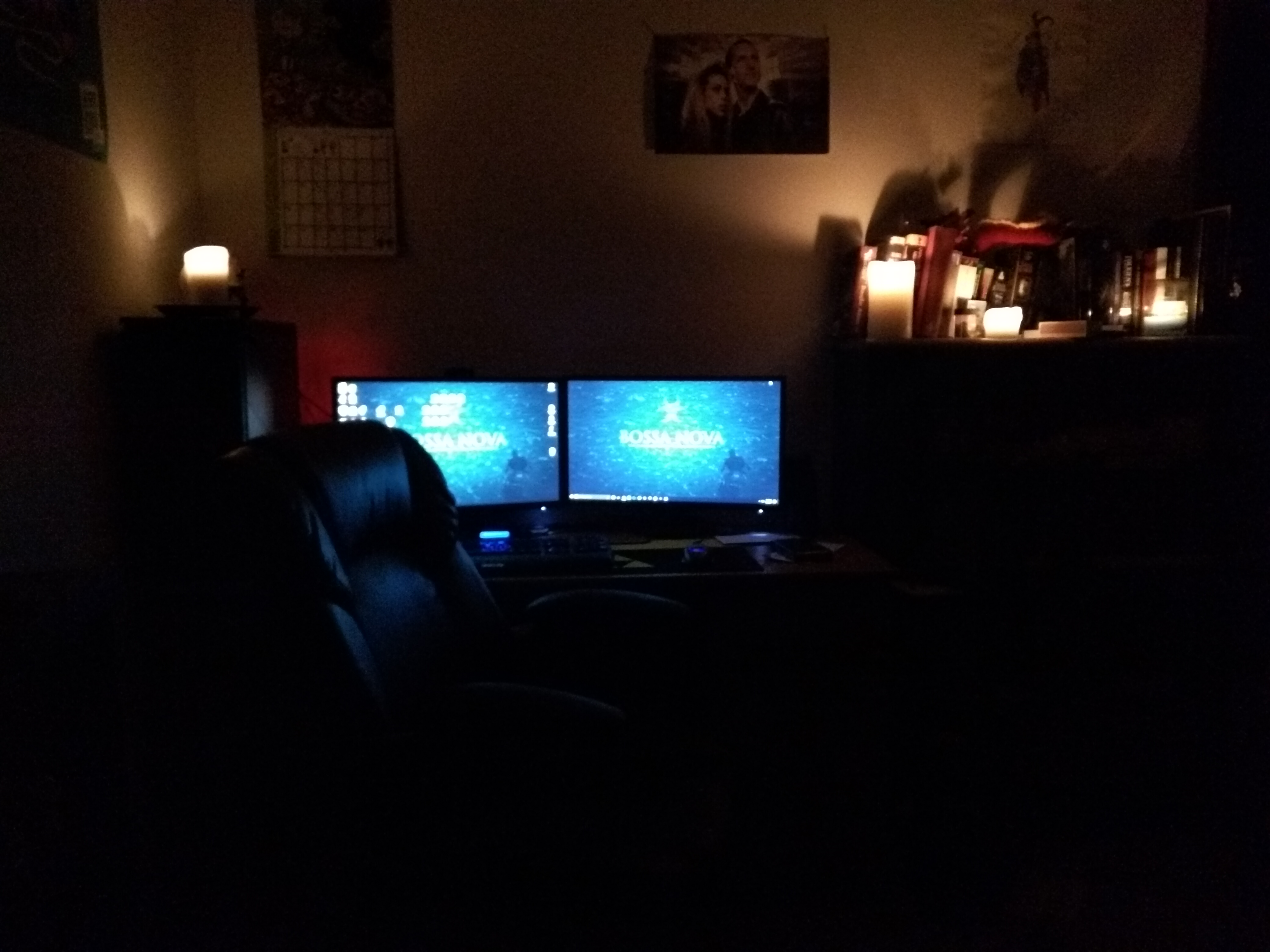
No, tonight I was thinking about whether or not I’d be able to write candles off as a business expense on a tax return. I like to work at night in as dim lighting as possible. I’ve tried a variety of programs to dim/change the light on my monitors (f.lux is my favorite since it cuts down on the headaches I get from looking at a computer screen too much), but eventually I always feel like I am getting stabbed in the eyes if I work in pitch darkness. I hate fluorescent lighting with an undying passion and haven’t found a dim incandescent light bulb I like, so I tend to lean toward candles.

Candles 6152017

Looks nice, yeah? WAY better than light bulbs.

Unfortunately, light bulbs are WAY cheaper than candles. I’ve yet to find a good deal on bulk pillar candles (tapers aren’t worth the bother), so that means occasionally going to target and dropping $50+ on candles I can only really expect to last a month of writing sessions. At most. And those are just plain, white, unscented candles. If I actually wanted them to smell like anything, that price could easily double.

When you’re living on a budget that’s kept tight for maximum student loan payment, its REALLY hard to justify $50 in candles. It’d be way easier to justify if I got something back for them when it came to filing my taxes.

This may be a problem that’ll only need an answer when I’m a successful novelist and, since I’ll likely have the money (and eccentricity) to just circumvent the entire issue by making my own candles, the answer is likely to be irrelevant by the time I’ve got it. Keeping bees has always sounded like fun to me. It’d give me something to do when I can’t write. Then, when I’m trying to sell a book to a publisher, I can advertise my “honeyed words” and laugh my ass off when I mail a manuscript whose pages are stuck together using the other by-product of bee-keepership.


A Place of Peace and Quiet

Depression sucks. You get all geared up to post three times a week, work on writing every day (at least a little bit), and maybe sleep a little more if you can do all that before midnight before getting slapped back down into the emotional pits by the heavy hand of ever-present depression.

My depression always takes the form of exhaustion. Sure, there’s a certain degree of listlessness and negativity that goes with it, but the constant, ever-present face of my depression is a sense of exhaustion always hovering at the edge of my mind.

Any kind of exhaustion or tiredness I experience can trigger it to come tumbling down on top of me. A frustrating problem at work that is intellectually taxing; a long day of dealing with people and the requisite emotional output; a long hike or hitting the gym hard. All of these things can trigger it or compound it, leaving me unable to break free of it.

This exhaustion is always there, always beckoning me toward lethargy and, eventually, a complete lack of motion. It takes energy to throw that feeling off, to push out of the haze it pulls me towards. The whole thing can be frustrating because pushing it off often results in it coming back worse once I’m no longer actively pushing it away.

When it starts to take over, I sometimes have to give into it and let it slow me down, let myself drift toward the precarious edge hinted at in coy phrases like “a complete lack of motion” or “the deepest rest.” Its terrifying. Which is also exhausting.

You can probably see the issue there.

I spend a lot of time managing myself and administering self-care in order to avoid the feedback loop I just described. Thankfully, this sort of management and caution plays right into most of my obsessions and compulsions from my OCD, so it can often be counter-intuitively relaxing. The most relaxing thing I did in the past month was take an entire day, on which I was off of work for a holiday my employer observes, to rearrange my bookshelves, setup my video game console recording gear, and to reorder my entire bedroom to better reflect the direction I see my life and my mind going.

There is a lot of psychology and philosophy out there that suggests the environment one finds most relaxing is one that best reflects oneself. Most people who know me would say that’d be somewhere in nature, far away from the city, where a sense of peace and steadfast endurance exists. Mountains or great forests.

To me, though, the place that best reflects me is my abode.

I live on the edge of cities, caught between the quiet I need and the chaos I love to watch. I’m surrounded by a frenetic energy I don’t understand and a populace I struggle to connect to. Within that bubble of disorder and unknowable insanity, I have a place I live that is–aside from the portions effected by my current roommate–strictly ordered, neat, and calm. I decorate in more muted colors, favor ambient music and light that lends itself toward creating a calm environment, and tend to prefer the quiet of my own company over the obtrusive noise of other people.

My mind is like that. Longer ago than I can even remember, I create a small place of order, quiet, and calm in my mind, tucked away inside the chaos created by how I grew up and the chemical imbalances biology has bestowed upon me. A small room of peace amidst the constantly growing chaos of my mind. There is no place more relaxing to me than my room or home. When I meditate, I always seek out that place of peace within myself.

I do need to get away sometimes. There is a huge value to be found in the quiet tranquility of a cabin far away from any city or civilization. There is a huge value to be found in the experience of a new city and the new chaos that is both challenging and rewarding. Sometimes the strength you need is found by going outside yourself and sometimes its found by going deep inside yourself.

When I really need to relax, to let the exhaustion finally slide away on its own, I spend my time in the peace and quiet of my home. I sit and read for hours at a time. I reorder my space and let it represent the less tangible reordering of my mind. I cut off all communication to the outside world aside from one or two lines to particular individuals and just let myself sort of expand to fill the space. Stop trying to cram everything into that tiny little space in my head and let the order I’ve created do the work for a while.

I’m pretty sure its coping mechanism, but I’m not terribly concerned so long as it helps me push back against the ever creeping exhaustion. Pretty much everything in life is a coping mechanism to one degree or another.


Hike Up Your Pants and Climb

Every time I sit down to write, I’m reminded of the mountain I’ve got to climb to reach any of my goals. Publish a book. Make enough money to live off my writing. Update my blog 3 or more times a week for a year (haha, right??? I can’t even do this for a week). All of these things require a huge commitment from me in not only time, but in energy and self.

Every time I want to write I have to marshal my thoughts and set aside whatever else has occupied my day. I have to stop thinking about bills, student loans, doing laundry, trying to find a date, and whatever pointless bit of minutiae my anxiety has fixed on. Then, as soon as that’s done, I need to collect my thoughts about whatever project I want to work on. After that, there’s the constant need to spend a decent amount of energy keeping those thoughts collected and the incessant report of my anxieties knocking against my defenses, trying to worm their way back in. The act of writing itself takes a part of me that I keep from the world the rest of the time and puts it somewhere I INTEND people to see, so it can be difficult to do with the kind of confidence needed to actually do more than make a half-assed attempt.

Even when it was easier, when I was writing every day, there was never what you could call an “easy” day. I may have had an easier time getting myself to sit down and do it, but it was never easy to actually do. I’ve spent a huge amount of time thinking and writing about the difficulties associated with writing. I’m always interested in reading what other writers have written about the act of writing. I’ve got a whole sub-classification of my poetry that is specifically about my difficulties in writing or how often I feel like none of the words I produce are the right ones. I’ve got a whole blog that is currently themed after the concept of struggling to find and use my words with undertones of how much I struggle to actually do it.

I’m pretty well versed in this kind of adversity, clearly. I could probably write a doctoral thesis on it (and might someday, depending on whether or not I actually go for an advanced degree in the future).

It does get easier to do, the more often you do it. I know that. You probably know that. Its true of pretty much everything one can do. It’s also true that there’s a point of diminishing return where it stops being noticeably easier. I would like to get back to that point, sure, but that just means I’m better at getting on the mountain to work on climbing it. It doesn’t actually make the mountain smaller.

Even in an ideal situation, with time to write every day and a minimum of other worries to keep away, I’ve still got a daunting task to accomplish. Not only that, I’ve got two I need to complete in a row to really count them as the success I want to see. I can’t just write a book, I’ve got to get myself to the point where I can write full-time.

Sitting here, at the base of all three of my mountains, I can tell you it’s really hard to make myself start walking up any one of them, much less split my time between all three. It seems far more tempting to find a path with some nice hills and valleys, some easier treks to try before I really make an attempt at any of my mountains.

I’ve never been very good at letting myself off easy, though. As much as I really want to consider something easier, as much as I’d like to take the easy route, I know the only reason I’d ever wind up in those hills and valleys is if I fell off one of my mountains. I may doubt myself constantly and wonder if I’m as good as other people have said (one teacher had to pretty much beat it into me and I’ll be forever grateful), but I know I’m good at trying again.

As today literally showed me, doing something again is always easier than doing it the first time and, somethings, you’ve just got to hike up your pants and climb that stupid rock. I did. There was a great view at the top. Maybe, someday, I’ll be able to say the same thing from the top of one of my metaphorical mountains.


In more business-y terms, I’m in the process of setting up some streaming and video-recording capabilities on my computer, solely so I can make and upload a “1000 Ways to Die: LoZ Edition” video along with the review I eventually post of Breath of the Wild. I might link a YouTube account to this thing or just post all my videos here if people are interested. Other potential videos include a “Naked and Afraid” run-through of Breath of the Wild” which will likely be the source of many of the 1000 deaths and something to do with the Dragon Age franchise. I dunno. Maybe some kind of heavy RP and story-telling element video. We’ll see. I’ve got a history of planning bigger projects than I can accomplish, so take that all with a grain of salt.

A Title Would Definitely Help This Post

I’ve had a busy couple of months. Adjusting to my job followed almost immediately by the new Legend of Zelda game. I did nothing but play on my Nintendo Switch for about three weeks and then spent another week avoiding my TV and computer and Switch as much as possible while I recovered from my binge. No regrets, though. I’ve already started a second play-through and have a third planned that I might either record or stream. We’ll see when the time comes. I’ll eventually review the game as well, probably as my next post.

While all this has been going on, I’ve been taking the opportunity provided by not having my soul drained as a result of my day job to spend some time reflecting and growing, something I’ve apparently ignored over the three years I held that awful job. Its been interesting to see just how much I’ve changed as a person. I’m a lot less likely to take abuse (which is probably a direct result of said awful job), I’m a lot less likely to cling to the past, and I finally stopped holding onto stuff for no other reason than it stirs a strong emotion in me. Almost all of those strong emotions weren’t positive ones, to be honest. I was pretty subconsciously masochistic, apparently. It explains a lot. Coincidentally, my closet is now emptier than it has been in years.

All that being said, I don’t feel like I’m in much of a different place than I was when I last updated. I’ve only just started working on my writing again. I still don’t know how to push back against the insanity infecting the world and some of those around me. I still feel like I’m drowning in a sea of student debt and self-inflicted problems. If anything, I’m a bit less worried about it all and a bit more restrictive on how long I’ll let myself freak out about anything.

I do know I tend to feel tired more often, but generally in a much more balanced sense. My old job used to emotionally drain me or intellectually drain me. I never got a nice, well-rounded exhaustion from it like I do from my current job. Today, after spending almost 8 hours trying to figure out settings and hardware setup, I finally managed to get everything working and do the one hour (if that) of work I needed to get done today. It was frustrating beyond words. I nearly burst into tears when I made the adjustments I needed in order to add another piece of hardware to the system and everything worked on the first try (previous attempts had added at least an hour per additional piece of hardware).

It was exhausting physically because this hardware isn’t light. It was exhausting emotionally because I’m new and half the problems were me screwing things up. It was exhausting intellectually because I had to learn as I went and try to remember everything my senior coworker taught me. Now, I can barely make myself get out of my chair and the blog entry I’m writing feels like a rambling, barely coherent mess. But today, as I went to the grocery store to buy myself a bag of my favorite chips, I wasn’t buying them because I was tired and exhausted and my day was rough. Today, I bought them as a reward for solving a really tough problem, for being recognized by my coworker for doing a good job with a complex issue, and because I deserved some kind of self-recognition for succeeding when I wanted to quit.

That little change in mindset makes all the difference. I may not have the solutions to the world’s problems, I may be actively considering giving up my dream of being a successful novelist for the more practical goal of just being really good at my current job, and I may have very little desire to ever move from this spot again, but I did good today. I can say I gave 100% of my effort into something that was ultimately rewarding and fulfilling. It feels good. It is what will push me out of this chair in another ten minutes and it is what is going to sit me down at my computer after dinner to spent two hours or more working away at my current book project.

I may not be happy right now–I’m definitely grouchy bordering on almost hysterically tired–but I’m feeling more fulfilled than I’ve felt since I wrote the end of a story for the first time. To me, happiness comes and goes but fulfillment is something that can stick around forever. As long as I feel fulfilled, nothing else really matters to me.

I suppose I might be in the same place I was a few months ago, but I definitely know I’m headed somewhere new.

What Does That Even Mean?

25 days after my last post and a solemn promise (even if it was made mostly to myself) that I’d write twice a week, I’m back again. In my defense, I’ve been pretty busy changing jobs, missing my old coworkers more than I anticipated, and working myself to the brink of exhaustion at my new job because they pay overtime. I’m a former student with a ton of debt just hanging out. Overtime is the only thing that’s gonna make it go away before my 30’s.

To be honest, the only reason I’m writing this post at all is because of my growing desperation to do something in response to President Trump’s actions. There’s so much wrong with what he’s doing and how he behaves on a day-to-day basis that I often feel that addressing it is hopeless. His supporters are almost impossible to engage because I can’t help but feel that they’re deliberately misinterpreting what I’m saying or that they’re purposefully ignoring everything but the specific interpretation of events that they’ve arrived at.

The worst part of it all is that everyone on both sides of the current issues seems to be leaping to the extremes. I’ve been fairly closely observing the world around me for my entire life and I don’t think I’ve ever seen something so polarizing as President Trump’s campaign and first week of presidency. I’m a Liberal at heart, but I tend to behave fairly moderately. I’m willing to compromise and take smaller steps to achieve lofty goals. I try to avoid being angry with people and believe that everyone, regardless of their words and actions, deserves to be treated like a human. With every passing day of President Trump’s governance, I feel more and more alone in the middle.

The thing is, despite being in the middle, I’m definitely not on the fence. I have very strong beliefs about the way the world should work and I’m quick to point out where there  can be some improvement, but I generally prefer to encourage people to be good to each other than prescribe ways of living. My whole outlook on life and value set can basically be summarizes as “don’t judge people, be kind to one another, and everyone’s rights extend right up to the point where they start to restrict or invade other people’s rights.” Simple enough, right? Hell, you can probably summarize it even better the same way most ancient religions can be summarized: “don’t be a dick.”

Unfortunately, the current president of the USA can’t seem to embrace that idea and seems hellbent on not only undoing all the accomplishments of the past 8 years, but also on establishing himself and his political cohorts as the constant major ruling force of the USA. He seems more interested in pushing the limits of his power than using it to the benefit of the people who put him in office. His pursuit of adulation and wealth borders on the insane, as does his pathological ability to find an insult or slight in everything people say about him. He seems to hate the same way he breathes: automatically and without cessation. He places absolutely no stock in his words, flinging them out without consideration and abandoning the ones he’s dropped in the past in favor of whatever he thinks will best suit his unknown and unfathomable agenda.

He’s pretty much the complete opposite of me, in every way I can find to make a measurable comparison.

To me, words are some of the most important things we have to offer to the world, though song or speech, book or movie, or even the more abstract expressions in the visual arts. Communication. Nothing is more important to me than how we communicate with each other and the ways we choose to do it. That’s the reason I’ve stuck with this admittedly rather dramatic name for my blog. I inwardly cringe ever so slightly every time I read it because it feels so “emo poetry” when I read it to myself. That’s not what the title means to me, though, even if I can’t help avoiding that meaning when I consider it (I mean, I’ve written some of that cringy emo poetry, so I know how it can appeal to a person).

The tagline under the title, “The words of power that make, the words of point that take: no matter what one may say, if you use these words they break.” is the last stanza of a poem I wrote from a collection I’ve never really shown to many people that I call “Speechless.” I struggle with finding the right words a lot. I’ve always liked to take the time I feel I need to be sure of what I’m saying and there are a lot of times I’ve stayed silent because I wasn’t able feel that level of surety. Sometimes I found them too late to be of any good to me and sometimes I never found them at all.

Poetry has always been an emotional outlet for me, a way to take something I’m experiencing and put it outside of myself in a way that I can start to deal with it. For all of the “Speechless” poems, they’re all about times that words failed me. From the simple one-stanza “Words” to the much longer “Broken Words” that goes on for about three pages, they’re all about times I felt myself inadequate to the task of properly expressing myself.

This blog, for those who don’t care to look back to the first post, was supposed to be an attempt by me to push back against my tendency toward silence and my feelings of being inadequate when it comes to self-expression, which is why it was given the same name as the poem that is probably not only the core poem in the “Speechless” collection but may also be the best poem I’ve ever written. “Broken Words” is all about the power that words have and the fact that they will never mean entirely the same thing twice.

Sure, every word has a dictionary definition, but each word we use is affected by the words around it, by who says and when they say it, by the reason they are perceived to have said it and the reason they actually said it, by the way the listener heard it and by the way it might have been overheard by someone else. Words, like people, don’t exist in a vacuum. They’re constantly evolving and their meanings are always open to some interpretation. They’re little crystalline pieces of ourselves that we send out into the world to never get back, even if no one else heard them. Whether they’re the good parts of ourselves or the bad parts is up to the speaker, but they’re always a part of us and they always shatter as soon as they tumble from our mouths or occupy pixels on a screen, never to be seen in entirely the same way again.

I can promise this blog won’t become a platform solely for speaking out against the bullshit I see in the world, but I can’t promise that it won’t more often be my soap box than my creative outlet. As I’ve always wanted to say and never had the chance to, you can’t make a change in the world without breaking a few thousand words.